What they wrote, how, and why: the music of the Collegiate Church in the eighteenth century
In Lu, a small village in the hills of Monferrato, the clergy of the Collegiate Church of Santa Maria Nuova wrote music just like this, as you can see in the display case in front of you. In the first half of the eighteenth century they copied plainchant and canto fratto (measured chant) and composed new pieces. In some pages they left traces of “simple” four-part polyphony, which recalls some of the sounds of multipart music of oral tradition.
Code Names
Antonio Francesco Colli (1665–1743), first steward and then provost of the Collegiate Church, is one of the names that recur most often in the manuscripts of the parish archive. He almost always appears in encrypted form, through learned devices, together with Benedetto Colli (17th-18th century), Giuseppe Boltri (1681–17??) and other code names that have not yet been identified.
The compilers’ signatures are encrypted with numbers or transliterated into the Hebrew or Greek alphabet, as can be seen in the example on the panel. We can imagine that it was a game among the canons, who perhaps exchanged books between the parishes, or perhaps did not wish to make their names known to those who could read and had access to the volumes. The precise meaning of this practice remains, for us, still in doubt.
Music and Daily Life
Colli’s books are dedicated to the three main parishes of the village: Santa Maria Nuova, San Giacomo and San Nazaro. They collect the chants probably used in everyday liturgy, with notes by the copyists indicating the liturgical occasion, as was customary at the time. But they also recount anecdotes of daily life, from the weather to the clothing it called for, and even episodes of historical significance, such as the death of Ferdinando Carlo Gonzaga, the last of his dynasty to hold control over Monferrato. Here are a few examples:
“In oppido Lu, die undecimo mensis quintilis. Venne nova qui à Lù che il signor duca Ferdinando Carlo Gonzaga, duca di Mantova, morià in vent’ hore di morte violenda, in Padoa li V luglio 1708, hore 11.”
(In the town of Lu, on the eleventh day of July. News came here to Lu that the lord Duke Ferdinando Carlo Gonzaga, Duke of Mantua, died within twenty hours of a violent death, in Padua on 5 July 1708, at 11 o’clock.)
“Quest’hinno, parimenti del quinto tono, feci 6 sestile 1725: transfiguratio domini, cioè corre hoggi il Vangelo di quel bel paradiso fatto per noi. Adesso sì San Pietro dirà da dovero: Bonum est nos hic esse; ah quando potremmo dir così anche noi.”
(This hymn, likewise in the fifth mode, I made on 6 August 1725: the Transfiguration of the Lord, that is, today’s Gospel is that of the beautiful paradise made for us. Now indeed Saint Peter will say in earnest: It is good for us to be here; ah, when might we too say the same.)
“Deus creavit duo Luminaria magna, Solem et Lunam in Celis. / Romam, et Lù in terris; ergo post Solem Lunam, et post Romam Lù.”
(God created two great lights, the Sun and the Moon in the heavens. Rome and Lu on earth; therefore, after the Sun [comes] the Moon, and after Rome, Lu.)
In these pages the liturgical and musical life of the canons and their daily life coincide: the book is the place where they meet.
A Provincial Elite
These learned and confidential exchanges also reflect the social position of the canons. Lu Monferrato was a small place within the Catholic world, but the canons came from well-to-do families and kept in contact with prominent figures active in more important centres. Indeed, in 1748, thanks to the intercession of the Apostolic Datary Giovanni Giacomo Millo (1695–1757), who lived in the Papal States and was originally from Casale Monferrato, they obtained the privilege of wearing the cappa magna and the rochet, reserved for the highest ecclesiastical ranks.
The portrait of Pier Francesco Guala, kept in the room just before this display case, captures precisely this solemn moment.
The Seven Canons of the Portrait
The names of the seven canons in the painting appear in the pastoral visit of Monsignor Ignazio Della Chiesa in 1748, carried out on the occasion of the great celebration. Among them are an Antonio Colli and a Giuseppe Boltri, but unfortunately they share their names with the two “musicians”, who both died a few years earlier. They certainly belonged to the same families and surely knew the work of their predecessors.
It is in fact probable that this musical tradition was maintained and cultivated afterwards as well, and it should be read in light of the continuous interplay between centre and periphery, in which the idea of an elite was handed down precisely through the preservation of established customs and traditions.
The musicians’ own presence in Guala’s painting would have been an extraordinary coincidence, and a very rare, given that they were non-professional composers active only in a small centre. But a more intimate and truthful portrait can be found in the many words Colli left in writing.
Antonio Francesco Colli: From Steward to Provost
As steward of the Collegiate Church, Colli was responsible for keeping the registers of baptisms, marriages and deaths. He did so until 1717, when, after the death of his predecessor, he was appointed provost. We can read his account in the Book of San Nazaro, which he compiled:
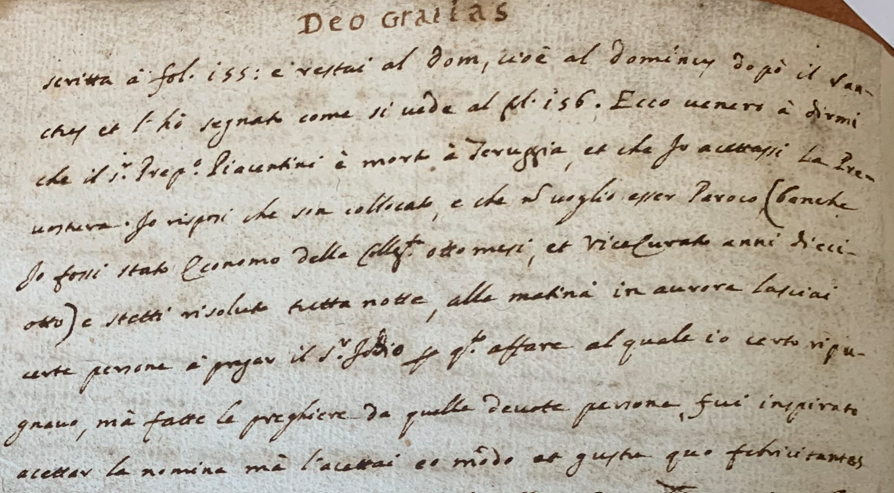
“Deo gratias. = L’anno 1717 lì 17 settembre a hore 23 in venerdì stampavo la messa qui scritta a fol 155: e restai al dom, cioè al Dominus dopo il Sanctus et lì ho segnato come si vede al fol 156. Ecco venero à dirmi che il signor Preposto Piacentini è morto à Perugia, et che io accettassi la prevostura. Io risposi che son collocato e che non voglio esser Paroco (benché io fossi stato economo della Collegiata otto mesi, e vicecurato anni dieci otto) e stetti risoluto tutta notte, alla matina in aurora lasciai certe persone à pregar il Signor Iddio a questo affare al quale io certo ripugnavo, mà fatte le preghiere da quelle devote persone, fui ispirato accettar la nomina […]”
(Thanks be to God. = In the year 1717, on 17 September, at the 23rd hour on a Friday, I was writing out the Mass set down here at fol. 155: and I stopped at the “dom”, that is, at the “Dominus” after the Sanctus, and there I made a mark, as can be seen at fol. 156. Behold, they came to tell me that the Provost Piacentini has died in Perugia, and that I should accept the provostship. I answered that I was settled and did not wish to be parish priest (although I had been steward of the Collegiate Church for eight months, and vice-curate for eighteen years), and I remained resolute all night; in the morning at dawn I left certain persons to pray to the Lord God over this matter, to which I was certainly averse, but after those devout persons had prayed, I was inspired to accept the appointment […])
The episode takes place at the very moment Colli was composing one of his Masses. Leafing through the book to page 155, one notices that, just as he wrote, the Mass stops at the Sanctus. The Agnus Dei was in fact added a few months later, when Colli had evidently settled into his new role.
The same news can be read beside his baptismal entry: Colli looked for his own name in the registers he was responsible for compiling, and left there, for posterity, a record of his position in the community.
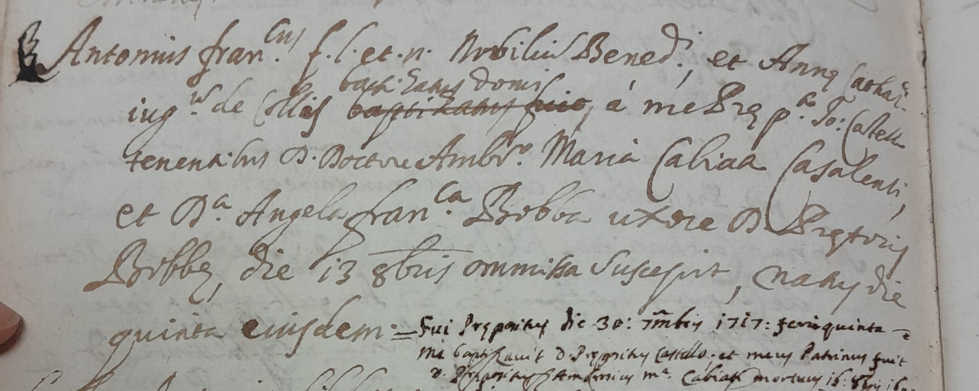
“Fui Prepositus die 30 septembris 1717: feria quinta […]”
(I became Provost on 30 September 1717, a Thursday […])
Writing, and Leaving a Trace
The desire to write—all-consuming in Colli, bordering on graphomania—is expressed more timidly in the pages of his companions as well. He seems to be the leader, but this need must evidently have been fairly widespread.
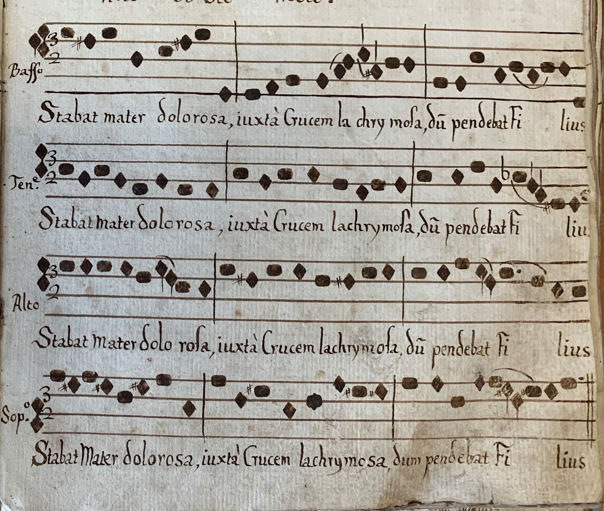
Among the other canons, the name of Giuseppe Boltri (1681–17??) stands out. His book contains the only four-voice piece in the entire repertoire, a setting of the sequence Stabat Mater, marked by a chordal style in which the voices mostly move together, recalling the sounds and style of sacred or devotional music of oral tradition, which today survive only in certain Italian towns or regions, but unfortunately not in Piedmont.
This Stabat, although the only piece with these characteristics (the other polyphonic pieces recall a more “scholastic” and contrapuntal style), is therefore a written trace that probably points to a deeper and more widespread polyphonic practice transmitted orally.
On the Threshold of the Twentieth Century
The desire to write and to make music did not stop in the eighteenth century. In the nineteenth-century volumes of the same collection we find books exchanged, earlier ones reused, and later additions to the masters’ pieces.
Like their predecessors, the canons copy traditional plainchant (the so-called “Gregorian chant”), but there are also interesting new polyphonic compositions, in which the organ makes an appearance, as well as particular insertions of nineteenth-century pieces still in use today, such as Noi vogliam Dio (“We Want God”), a hymn linked to devotion to Our Lady of Lourdes, added in 1909 by Filippo Bisoglio to the book of Gioacchino Ribaldone, originally compiled around 1840.
The tradition thus extends into the twentieth century: not only writing music, but also noting down the circumstances in which it was made.
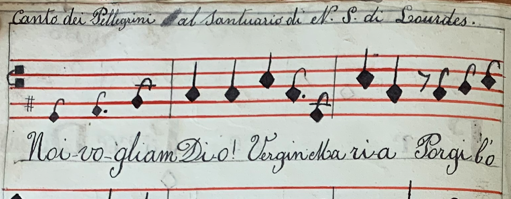

“Ricoppiata e diretta la prima volta da Bisoglio Filippo, 28 febbraio 1909, prima Domenica di Quaresima”
(Copied and conducted for the first time by Filippo Bisoglio, 28 February 1909, First Sunday of Lent)
Not Only Lu
Although the case of Lu Monferrato appears extraordinary, and of an exceptionality that can stir strong emotion, it would be a mistake to consider it isolated and unique. A similar repertoire was widespread in other parts of Piedmont and Italy, with evidence in Liguria and Calabria, and in other countries as well. Overshadowed by the weight of the Western canon, of the great composers of so-called “classical music,” and by the profound transformations of sacred music over the centuries, it has remained “submerged,” shut away in cupboards and dusty drawers, thanks to those who took care to conserve it and preserve it as the heritage of a precious memory.
From this point of view, the case of Lu Monferrato remains an evocative example of microhistory: a repertoire that seems distinctly local but that, if questioned with breadth of vision, may reveal a far broader value across time and space.
Amina Fiallo
The exhibit was curated by Giovanni Cestino, Amina Fiallo and Anna Martini (ITER Research Ensemble), in collaboration with the Museo San Giacomo.
Playlist
Antonio Francesco Colli (1665–1743)
Sequentia pro defunctis
[Antonio Francesco Colli’s Music Book], pp. 225–226
September 25, 1722, “die Veneris nebulosa” (a cloudy Friday)
Giovanni Cestino soloist (ITER Research Ensemble)
Cremona, Church of San Bassano, September 3, 2023
Anonymous (18th c.)
Stabat mater
[Liber] Pro ecclesia parrochiali Sancti Iacobi oppidi Lù, fol. 75v
Alessio Giuricin, Stefano Colombo soloists (ITER Research Ensemble)
Cremona, Church of San Bassano, October 21, 2023
Anonymous (18th c.)
Sequentia mortuorum / Sequentia defunctorum
“Dies iræ” – “Quantus tremor” – “Tuba mirum” – “Mors stupebit” (Alio modo)
[Liber] Pro ecclesia parrochiali Sancti Iacobi oppidi Lù, fols. 21v, 22r, 99r–v
ITER Research Ensemble
Cremona, Church of Sant’Ilario, March 14, 2026
Giuseppe Boltri (1681–17??)
Stabat mater
[Giuseppe Boltri’s Music Book], fol. 49r
ITER Research Ensemble
Milan, Rai Studio A (from La stanza della musica, curated by Oreste Bossini), May 13, 2026